
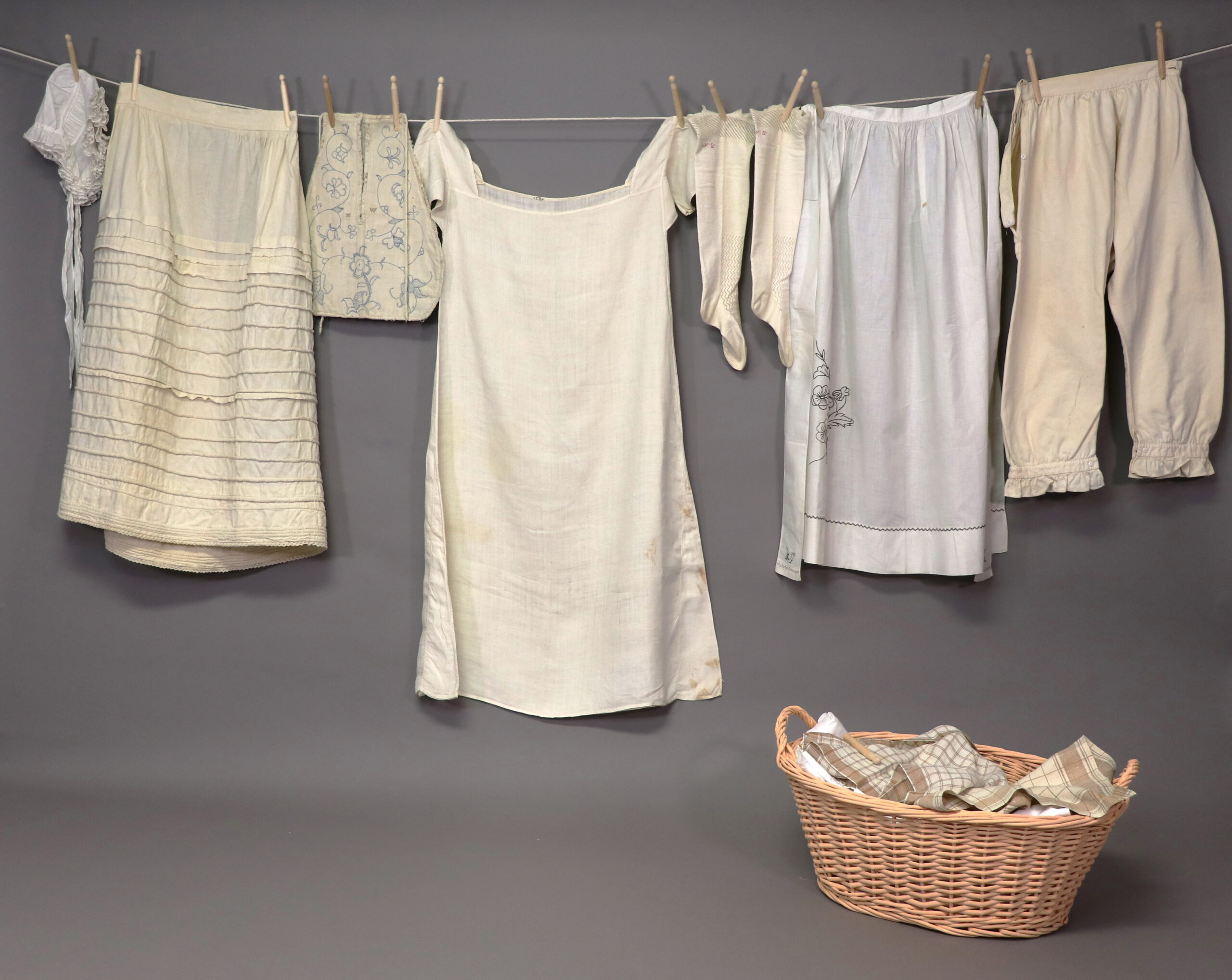


Sewing for Women
Garments women would usually sew for themselves included (but were not limited to) the shift (later called a chemise); petticoats; drawers when they began being widely worn in the second third of the 1800s; corset covers; stockings; and in the early 1800s, corsets. How many of each garment a woman had varied hugely by economic circumstance and over time (fabric becoming cheaper with industrialization). But based on evidence in diaries, letters, dressmakers’ accounts, and advice manuals, we know that in general, women above basic poverty levels had multiple changes of underthings and dresses, and most were adding at least one or two dresses for spring/summer and the same for fall/winter each year.
Many women also did much of the sewing of their dresses, even if they hired a dressmaker for help with fitting and cutting the bodice pattern—as many experts advised.
Cotton night cap, 1840s, DAR Museum, 2000.10.1
Corded cotton petticoat, 1820–1835, DAR Museum, 2005.49
Embroidered linen pocket, 1750–1790, gift of Abbie S. Sargent, 2423.2
Linen shift, 1795–1815, Connecticut, gift of Lucy Bishop Minor, 46.16
Cotton stockings, 1820s, gift of Grace Rheinstrom, 3231.A&B
Embroidered cotton apron, 1914, Indiana, 97.43
Cotton twill drawers, 1840s, gift of the University of Maryland, 2014.21.30